Inclusive and equitable teaching with technology: welcoming and supporting all our students

Flower Darby

Flower Darby is an author, educator and speaker who specialises in teaching and learning, design and practice in both face-to-face and online formats. She will be joining CREDI to present a seminar entitled “Inclusive and equitable teaching with technology: welcoming and supporting all our students”.

Wednesday 4 November 2020Flower Darby

2.30pm – 4pm

Abstract
Engaging our diverse students in all class formats is crucial to our societal well-being, yet we may not feel equipped to do so. Join us to explore theoretical frameworks and practical strategies that allow us to welcome and support all our students in equitable and inclusive online and in-person classes. You’ll leave with new ideas to apply in your teaching next week or next term, as we seek to better support our students’ ability to learn and succeed.

Flower Darby’s PowerPoint Presentation – Inclusive and Equitable Teaching With Technology Nov 4 2020

Access a recording of Flower Darby’s session below. University of St Andrews login for Streams is required.


Inclusive Leadership Signatures: A Social Cognitive Approach to Contingent Leadership Models

Professor Robert Wood

Professor Robert Wood
Macquarie University, Australia
2025-2026 University of St Andrews Global Fellows.
St Andrews University Business School

Leadership studies typically use fixed measures of people and situations in between person analyses and base inferences about leadership behaviour on relationships between group level means. There are many limitations to this approach; group means may not be representative of many group members, group level relations may differ from the same relationships at the individual level (Simpson’s paradox), and leadership behaviours and situations are not fixed. Contingency theories of leadership recognize differences in leadership styles and situations but are subject to the same limitations, which may explain the lack of supporting evidence and decline in contingency leadership studies. In the current study, we use the intrapersonal dynamic personality processes approach and the CAPS model (Mischel and Shoda, 1995) to operationalise a leadership signature, an individual unit of knowledge that captures the contingent relationship between self-evaluations and leader identity, calculated using repeated measures over 36 week. The resulting individual level leadership signatures (N= 227) are then used to predict leadership emergence in initially leaderless student dorm groups (N=37). Results show that (a) changes in leader identify ratings are contingent upon self-evaluations of leader performance, (b) there are stable individual differences in leadership signatures, and (c) individual differences in leader identity signatures are related to leader emergence, based on peer ratings. Strength of the leader identity signature relationship is stronger for those with prior leadership experience. We discuss the potential of using leader identity signatures and related contingent constructs as explanatory mechanisms for leader behaviour and resulting outcomes, such as inclusivity and diversity management, as well as the retesting of older contingency theories of leadership.

Financial decision making of young adults: Struggling to do as well as your parents

Professor Robert Wood

Professor Robert Wood
Macquarie University, Australia
2025-2026 University of St Andrews Global Fellows
St Andrews University Business School

In many developed countries, the current generation of young adults is the first cohort since WWII whose financial wellbeing will be less than that of their parents. They are also the group most impacted by rising inequality and efforts to combat climate change. A longitudinal, multimethod exploratory study collected data from seventy young Australian adults (18 to 40 years old) over a period of 7 months, which included a significant rise in the cost of living. The results of this exploratory study are the basis for a similar study being planned for Scotland. We investigated several topics. This talk will report results for two of the topics studied; financial adaptation by young adults during the cost-of-living crisis and how young adults navigate the intersection of personal finance and climate-conscious decision-making. The results highlight the importance of operational flexibility for financial resilience, e.g. willingness to utilise available financial resources and products, to change lifestyle and consumption patterns, to find new sources of income, and to change or postpone goals. Personal traits were associated with financial resilience, notably optimism. Young adults care deeply about the environment but feel powerless to make a difference. Despite high interest in green technologies, cost and access remain prohibitive for young adults. Again, personality matters. Future-oriented individuals exhibit significantly more sustainable behaviors, such as lower fuel use, even after controlling for income, location, and environmental attitude. Policy implications and an agenda for further research are discussed.

Applying Social Cognitive Theory to study the dynamics of organizational behaviour topics

Professor Robert Wood

Professor Robert Wood
Macquarie University, Australia
2025-2026 University of St Andrews Global Fellowship.

The aim of this workshop is to equip students with knowledge of the models and methods for a dynamic approach to the study of individuals in organizations and to identify research questions and opportunities for application of the dynamic approach in your area of interest. The workshop will cover the following topics;

  1. Between person approaches to the study of individual and situations in organizational behaviour research.
    • Assumptions, measures and analytical methods.
    • The problem of using nomothetic results to make idiographic inferences.
    • Research opportunities in two key but understudied constructs, agency and development.
  2. Social cognitive approaches
    • States versus traits
    • Dynamic personality processes, models and measurement
    • Emerging research evidence
  3. Research opportunities
    • Your research topic – key research questions and evidence base
    • Using the Triadic Reciprocal Determinism model (Bandura 1986) to identify research questions and opportunities in your topic
    • Turning the research question into a research project

Formal financial education has its limits

Tuesday 1 July 2025
12pm – 1.30pm
Lecture room 2, Gateway Building

Presenter:

Dr Steve Agnew, University of Canterbury Business School, New Zealand.

Gateway Building in July sunshine

The topic for this research talk is, ‘Formal financial education has its limits: if we want adolescents to be better with money, we need to start at home‘.

Dr Agnew will share findings from the Financial Capability in the South Pacific project, funded by The Pacific Fund and the Pacific Islands Universities Research Network (PIURN). The presentation will:

  • analyse predictors of adolescent financial confidence
  • consider social and cognitive predictors of financial knowledge
  • make comparisons between the contrasting contexts of New Zealand and the Cook Island
  • discuss an initiative aimed at enhancing positive financial socialisation of adolescents in the home.

All welcome.
Lunch will be served. To register your attendance, please respond to the invitation that has been circulated, noting any dietary requirements.

Seminars with Dr Mike Marinetto, Cardiff University

Gateway Building, with holly leaves in the foreground

Tuesday 25 March 2025, 12pm to 2pm
and
Wednesday 26 March 2025, 1pm to 2.30pm

The Boardroom, Gateway Building

Presenter:

  • Dr Mike Marinetto, Cardiff University.
These joint events with the the University of St Andrews Business School Department of Management’s Work, Organisations and Society thematic research group will welcome Dr Mike Marinetto from Cardiff University.

Dr Marinetto is Reader in Management at Cardiff Business School. His current research focuses on the intersection of business ethics and crime, particularly in relation to the accumulation of wealth through unethical practices.

Tuesday’s seminar is titled, ‘”Unfollowing the money”?: the epistemic, economic, and methodological case for “studying up” rather than “studying down” in the social sciences’.

On Wednesday the topic is, ‘Learn to write boldly (or, how to succeed in management studies): the case of sensemaking in organisation studies and scholarly self-promotion (via mediopassive constructions)’.

All welcome. Please reply to the invitations circulated to members or email Business School Research Admin on [email protected] and include a note of any dietary requirements.

Storytelling through craft: using stitch as a catalyst for feminist and change-making conversations

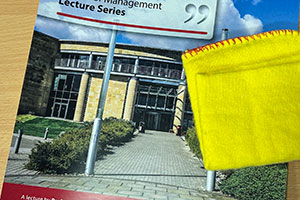
CREDI event image showing the Gateway Building on a poster with a yellow duster

Thursday 20 March 2025
10am to 11.30m
Seminar Room 4/5, Gateway Building

Presenter:

  • Vanessa Marr, University of Brighton.

This joint event with the the University of St Andrews Business School Department of Management’s Knowledge and Practice thematic research group will welcome practice-based researcher and maker Vanessa Marr, Principal Lecturer at the School of Arts and Media, University of Brighton.

Vanessa Marr will speak on the seminar topic, ‘Storytelling through craft: using stitch as a catalyst for feminist and change-making conversations’. She will also share her best-known project Domestic Dusters, which invites women to embroider yellow dusters with their experiences and perspectives of domesticity. The project is part of International Women’s Day activities at the University’s Wardlaw Museum.

All welcome. Please reply to the invitation circulated to members or email Business School Research Admin on [email protected] and include a note of any dietary requirements.


It is not just about the hot flushes and mood swings!

It's OK to talkWednesday 12 February 2025
12.30pm to 2pm
Seminar Room 6, Gateway Building

Presenter:

    • Professor Kristina Potočnik, University of Edinburgh.

This joint event with the the University of St Andrews Business School Department of Management’s Work, Organisations and Society thematic research group will include a seminar and networking lunch.

Professor Kristina Potočnik, Personal Chair of Organisational Behaviour at the University of Edinburgh Business School, will speak on the seminar topic, ‘It is not just about the hot flushes and mood swings! Exploring the role of employee agentic behaviours and support from employers and colleagues in managing menopause transition in the workplace’.

All welcome. Please reply to the invitation circulated to members or email Business School Research Admin on [email protected] and include a note of any dietary requirements.

Health, ageing and work: challenges and paradoxes of hiding in plain sight

Wednesday 20 November 2024
11.30am to 1pm
Seminar Room 1, School of Medicine

Presenter:

  • Professor Wendy Loretto, University of Edinburgh.

This joint event with the the University of St Andrews Business School Department of Management’s Work, Organisations and Society thematic research group will include a seminar, networking lunch and pre-booked one-to-one meetings.

Professor Wendy Loretto, Professor of Organisational Behaviour and former Dean of University of Edinburgh Business School, will speak on the seminar topic, ‘Health, ageing and work: challenges and paradoxes of hiding in plain sight’.

All welcome. Please reply to the invitation circulated to members or email Business School Research Admin on [email protected] and include a note of any dietary requirements.

Early career researchers who would like to discuss career progression with Professor Loretto in an after-lunch session may book a meeting with her by contacting [email protected].

Photo by Danie Franco on Unsplash

All you need is equitable workplaces: addressing economic and power disparities to promote well-being at work

Gateway Building with May flowers in frontTuesday 21 May 2024
1pm to 2:30pm
Lecture Room 2, Gateway Building

Presenter:

  • Dr Silvia Filippi, University of Padova.

This joint event with the the University of St Andrews Business School Department of Management’s Work, Organisations and Society thematic research group and its EDI committee will include a networking lunch at 1pm followed by a seminar at 1:30pm.

The session will consider:

  • workers’ well-being in organisations that have a large gap in pay between top managers and other workers
  • harm to women and men caused by inequalities at work
  • workers’ well-being and performance in organisations where power is decentralised.

All welcome.
Please email [email protected] to register your attendance, and for catering purposes include a note of any dietary requirements you may have.